
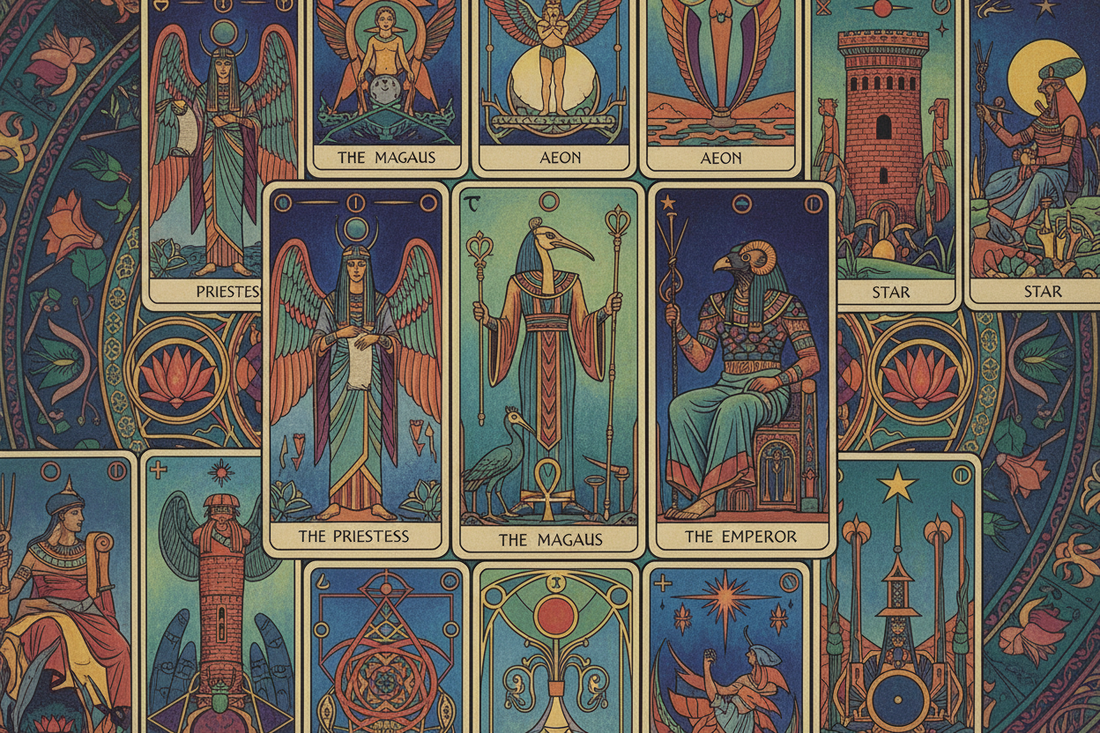
Thoth + Tarot: The Thoth Deck
BY NICOLE LAU
The Thoth Tarot, created by Aleister Crowley and painted by Lady Frieda Harris between 1938 and 1943, represents one of the most significant reimaginings of the tarot tradition. By grounding the deck explicitly in Egyptian symbolism and Hermetic philosophy, Crowley positioned Thoth—the Egyptian god of wisdom and magic—as the divine intelligence behind the cards themselves. The result is a tarot system that functions not merely as a divination tool but as a complete magical and philosophical framework.
The Genesis of the Thoth Deck
Aleister Crowley began developing the Thoth Tarot in the late 1930s, dissatisfied with existing decks' failure to incorporate the full depth of Hermetic, Qabalistic, and Egyptian symbolism. He envisioned a deck that would serve as a visual textbook of occult philosophy—a "Book of Thoth" in card form that encoded the wisdom traditions he had spent decades studying.
Crowley commissioned Lady Frieda Harris, a skilled artist with no prior tarot experience, to paint the cards. Their collaboration lasted five years and produced multiple versions of many cards as Crowley refined his symbolic vision. Harris's art deco aesthetic, combined with her willingness to incorporate complex geometric and symbolic elements, created a visual language unlike any previous tarot deck.
The deck was not published during Crowley's lifetime. It finally appeared in 1969, and has since become one of the most influential tarot systems in modern occultism, rivaling the Rider-Waite-Smith deck in popularity and far exceeding it in symbolic density.
Why "Thoth"? The Egyptian Foundation
Crowley's choice to name the deck after Thoth was deliberate and multifaceted. First, it connected the tarot to the legendary Book of Thoth, the mythical Egyptian text said to contain all magical knowledge. By calling his deck the "Thoth Tarot," Crowley claimed it as a modern manifestation of that ancient wisdom.
Second, Thoth's identity as scribe, magician, and judge aligned perfectly with the tarot's functions: recording truth (divination), wielding transformative power (magic), and rendering judgment (self-knowledge). The tarot, in Crowley's vision, was Thoth's tool—a system through which the god's intelligence could communicate with practitioners.
Third, the syncretism of Thoth with Hermes Trismegistus provided a bridge between Egyptian and Greek magical traditions, allowing Crowley to integrate Hermetic philosophy, Qabalah, astrology, and alchemy into a coherent symbolic system. Thoth-Hermes became the unifying principle behind the deck's complex correspondences.
Egyptian Symbolism in the Major Arcana
The Thoth deck's Major Arcana is saturated with Egyptian imagery, far beyond what appears in traditional tarot:
The Magus (The Magician)
Crowley renamed this card "The Magus" and depicted the figure as Thoth-Hermes himself, holding the caduceus and standing before a table of magical implements. The card represents the principle of divine intelligence manifesting through will and skill—Thoth's essential nature.
The Priestess (The High Priestess)
This card draws heavily on the imagery of Isis, the Egyptian goddess of magic and hidden knowledge. The Priestess sits between the pillars of the temple, veiled and mysterious, embodying the receptive wisdom that complements the Magus's active intelligence.
The Empress
Depicted with strong associations to Hathor and Isis in their fertile, creative aspects, the Empress represents the principle of divine motherhood and natural abundance—the generative power of the universe.
The Emperor
Connected to Horus, the falcon-headed god of kingship and the sky, the Emperor embodies authority, structure, and the establishment of cosmic order through will.
The Aeon (Judgment)
Crowley replaced the traditional Judgment card with "The Aeon," depicting the Egyptian concept of cosmic renewal. The card shows Horus emerging as the new aeon, replacing the dying god Osiris—a direct reference to Crowley's Thelemic philosophy and Egyptian eschatology.
The Court Cards: Egyptian Deities as Archetypes
Crowley restructured the court cards as Knight, Queen, Prince, and Princess, assigning each to specific Egyptian deities and elemental forces. For example:
- The Knight of Wands embodies the fiery, active aspect of solar deities like Ra
- The Queen of Cups reflects the watery, receptive nature of Isis and Hathor
- The Prince of Swords channels the airy intellect of Thoth himself
- The Princess of Disks grounds the earthy, material aspect of Nephthys and Geb
This system transforms the court cards from mere personality types into cosmic principles embodied by divine intelligences.
The Book of Thoth: Crowley's Companion Text
In 1944, Crowley published The Book of Thoth, a dense philosophical treatise explaining the symbolism, correspondences, and divinatory meanings of each card. The book is not a simple instruction manual but a comprehensive exploration of Hermetic Qabalah, astrology, alchemy, and Egyptian mythology as they relate to the tarot.
Crowley's text assumes significant prior knowledge and makes no concessions to beginners. He discusses the cards in terms of:
- Qabalistic correspondences – which sephirah and path each card occupies on the Tree of Life
- Astrological attributions – planetary, zodiacal, and decanate associations
- Elemental dignities – how cards interact based on their elemental nature
- Alchemical processes – stages of transformation encoded in the imagery
- Egyptian mythology – which deities and myths inform each card's meaning
The result is a tarot system of extraordinary depth, where each card functions as a node in a vast network of symbolic correspondences.
Thoth Tarot as Magical Tool
Beyond divination, Crowley designed the Thoth Tarot for active magical work. Practitioners use the cards for:
Pathworking and Meditation
Each Major Arcana card represents a path on the Qabalistic Tree of Life. Meditating on a card allows the practitioner to "walk" that path, experiencing the consciousness associated with that particular divine principle. The rich symbolism provides anchors for deep visionary work.
Ritual Invocation
Cards can be placed on altars to invoke specific energies or deities. The Magus card, for instance, serves as a focal point for invoking Thoth-Hermes during magical operations requiring clarity, communication, or intellectual power.
Talismanic Magic
Individual cards function as talismans. A practitioner might carry the Two of Disks (Change) to navigate a period of transition, or the Ace of Swords to cut through confusion and perceive truth.
Initiatory Study
The deck serves as a curriculum for occult education. Studying the cards in sequence—understanding their symbolism, correspondences, and relationships—provides a structured path through Hermetic philosophy, Egyptian mythology, and Qabalistic cosmology.
Divination with the Thoth Deck
The Thoth Tarot's divinatory style differs markedly from gentler, more intuitive decks. Its imagery is stark, sometimes confrontational, and refuses to soften difficult truths. Readings with the Thoth deck tend to be:
- Intellectually demanding – requiring knowledge of correspondences and symbolic systems
- Psychologically penetrating – revealing shadow material and uncomfortable truths
- Magically oriented – suggesting not just what will happen but what magical work is needed
- Philosophically rich – offering insights into cosmic principles rather than simple predictions
The deck rewards study. Superficial readings miss the depth of meaning encoded in the cards' intricate symbolism. But for practitioners willing to engage seriously, the Thoth Tarot offers unparalleled insight into the mechanics of consciousness, fate, and magical transformation.
Controversies and Criticisms
The Thoth Tarot is not without critics. Some object to Crowley's Thelemic philosophy, which permeates the deck's symbolism. Others find the imagery too abstract or the correspondences too rigid. The deck's association with Crowley's controversial persona has led some practitioners to reject it on ethical grounds.
Additionally, the deck's complexity can be overwhelming. Beginners often struggle with the non-traditional imagery and the assumption of extensive occult knowledge. Unlike the Rider-Waite-Smith deck, which can be read intuitively, the Thoth Tarot demands study.
Yet these same qualities—complexity, philosophical depth, uncompromising symbolism—are precisely what make the deck valuable to serious practitioners. It is not a deck for casual use but a lifetime study, a magical tool that reveals new layers of meaning with each engagement.
Thoth's Presence in the Deck
Throughout the Thoth Tarot, the presence of Thoth himself can be felt—not just in the Magus card but in the deck's fundamental structure. The emphasis on precise correspondence, the integration of multiple symbolic systems, the balance of intellect and intuition, the role of writing and language in magic—all reflect Thoth's essential nature.
The deck embodies Thoth's three roles: it records truth (divination as cosmic scribe), it transforms consciousness (magic as heka), and it judges accurately (self-knowledge as impartial assessment). In using the Thoth Tarot, practitioners engage directly with the intelligence of Thoth-Hermes, accessing the same wisdom that ancient Egyptian priests sought in temple libraries and that Renaissance magicians pursued through Hermetic texts.
Working with the Thoth Tarot Today
For modern practitioners, the Thoth Tarot offers:
- A complete system of Hermetic philosophy in visual form
- A bridge between Egyptian, Greek, and Qabalistic traditions
- A tool for deep psychological and spiritual work
- A magical instrument for ritual and meditation
- A lifelong study that continually reveals new insights
Approaching the deck requires patience, study, and willingness to engage with complex symbolism. But for those who make the effort, the Thoth Tarot becomes more than a divination tool—it becomes a direct line of communication with the divine intelligence that Crowley called Thoth, the Egyptians called Djehuty, and the Greeks called Hermes Trismegistus: the eternal principle of wisdom, magic, and transformative knowledge.
Related Articles

Divination Plants: Oracle Herbs from Laurel to Tobacco - Prophetic Botanicals & Cross-Cultural Fortune-Telling Wisdom
Discover Divination Plants—bay laurel, mugwort, tobacco, yarrow, tea leaves. Explore oracle herbs, prophetic dreams, ...
Read More →Discover More Magic


