
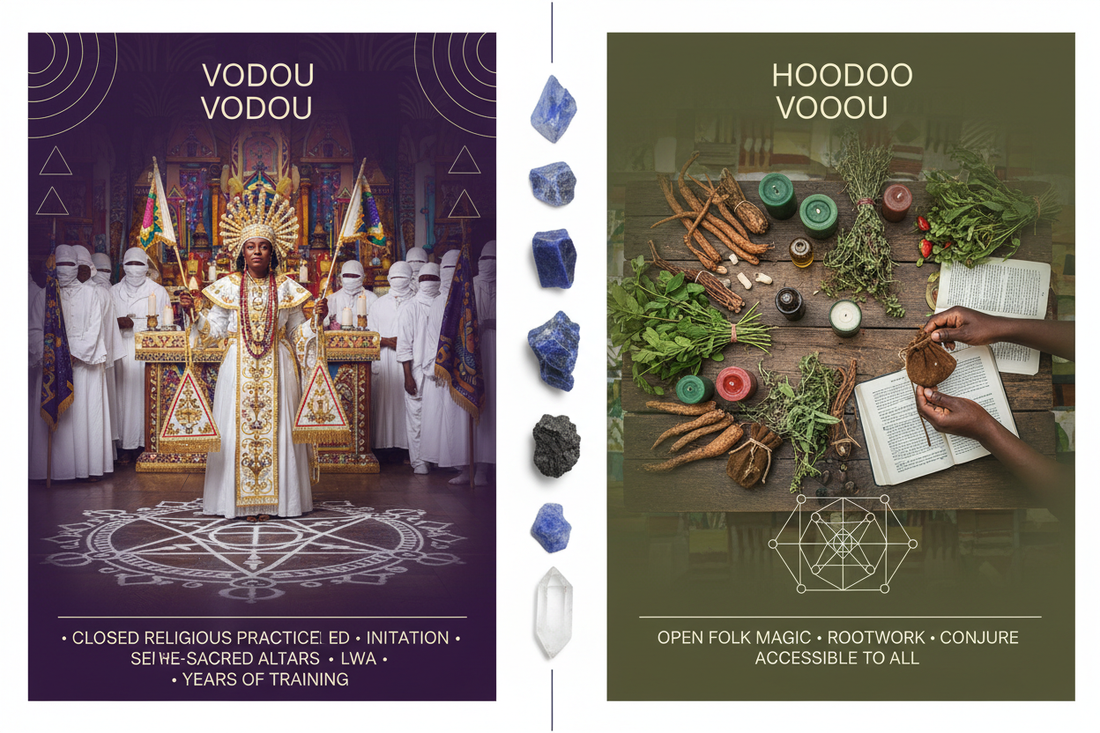
Voodoo vs. Hoodoo: Closed vs. Open African Diaspora Practices
BY NICOLE LAU
"Voodoo" and "Hoodoo" are often confused or used interchangeably, but they're completely different. One is a closed religion requiring initiation. The other is an open folk magic practice. One has priests, temples, and complex theology. The other has rootworkers, conjure, and practical magic. Understanding the difference isn't just academic—it's essential for knowing what you can and cannot practice, and for respecting African diaspora spirituality.
This article clarifies the crucial distinction between Vodou/Voodoo (closed) and Hoodoo (open), explains the African diaspora context, addresses harmful stereotypes, and guides you on how to engage respectfully with these traditions. Because lumping them together erases important distinctions and disrespects both practices.
Understanding Vodou/Voodoo
What It Actually Is
Vodou (also spelled Voodoo, Vodun) is:
- A complete religion, not a magical practice
- Originating in West Africa (Vodun) and Haiti (Vodou)
- With priesthood, theology, and complex religious structure
- Requiring initiation to practice
- Involving relationship with lwa (spirits/deities)
Key Characteristics
1. It's a religion
- Complete cosmology and theology
- Pantheon of lwa (spirits)
- Religious ceremonies and rituals
- Moral and spiritual framework
- Not just "magic" or "spells"
2. Requires initiation
- Cannot practice without being initiated
- Initiation ceremonies are complex and sacred
- Creates spiritual bonds and responsibilities
- Years of training and study required
3. Has priesthood
- Houngans (priests) and Mambos (priestesses)
- Hierarchical structure
- Lineages and houses
- Authorized practitioners
4. Community-based
- Practiced within community context
- Temples (hounfors) and congregations
- Collective ceremonies
- Not solitary practice
5. Closed to outsiders
- Cannot practice without initiation
- Cannot self-initiate
- Must be brought in by initiated priest/priestess
- Respecting this boundary is essential
Understanding Hoodoo
What It Actually Is
Hoodoo (also called rootwork, conjure) is:
- African American folk magic tradition
- Practical magic, not a religion
- Developed by enslaved Africans in American South
- Blending African, Native American, and European influences
- Open practice—anyone can learn and practice
Key Characteristics
1. It's folk magic, not religion
- Practical magical techniques
- No theology or worship
- Can be practiced alongside any religion (or none)
- Focused on results and problem-solving
2. No initiation required
- Can be learned from books, teachers, or family
- No formal ceremonies to begin
- Self-study is valid
- Accessible to anyone willing to learn
3. No priesthood
- Rootworkers and conjure doctors (practitioners)
- No hierarchical structure
- Individual practice
- Knowledge passed through teaching and learning
4. Individual practice
- Typically practiced alone
- Personal magical work
- No temples or congregations
- Though community and mentorship exist
5. Open to all
- Anyone can learn and practice
- Should be approached with respect for African American roots
- Learn properly, don't just make things up
- Give credit to the tradition
The Key Differences
Vodou vs. Hoodoo
| Vodou/Voodoo | Hoodoo |
|---|---|
| Religion | Folk magic practice |
| Requires initiation | No initiation needed |
| Has priesthood | No priesthood |
| Worship of lwa (spirits) | No worship (though may work with spirits) |
| Complex theology | Practical techniques |
| Community-based | Individual practice |
| Haitian/West African | African American |
| Closed practice | Open practice |
| Cannot practice without initiation | Can learn and practice |
| Temples and ceremonies | Personal magical work |
Why the Confusion?
How They Got Mixed Up
1. Racist stereotypes
- Hollywood portrayed both as "evil magic"
- Lumped all African diaspora practices together
- Created "voodoo doll" stereotype (not actually from Vodou)
- Sensationalized and distorted both traditions
2. Similar roots
- Both have African origins
- Both developed in diaspora
- Some overlapping practices and influences
- But they're distinct traditions
3. Linguistic confusion
- Similar-sounding names
- Both associated with African American/Caribbean culture
- Media using terms interchangeably
4. Lack of education
- Most people never learned the difference
- Misinformation spreads
- Stereotypes persist
Other African Diaspora Traditions
Also Important to Understand
Closed/Initiation-required:
- Santería/Lukumí: Afro-Cuban religion, requires initiation
- Candomblé: Afro-Brazilian religion, initiation-only
- Palo Mayombe: Afro-Cuban practice, strictly closed
- Ifá: Yoruba divination system, requires proper training and initiation
More accessible (but still require respect):
- Hoodoo/Rootwork/Conjure: As discussed, open practice
- Curanderismo: Latin American folk healing (context-dependent)
How to Engage Respectfully
With Vodou (Closed Practice)
What you CANNOT do:
- Practice Vodou without initiation
- Set up altars to lwa without being initiated
- Perform Vodou ceremonies
- Claim to practice Vodou
- Use Vodou imagery or symbols casually
What you CAN do:
- Learn about it respectfully
- Read books by initiated practitioners
- Support Vodou communities
- Respect it as a living religion
- If genuinely called, seek proper initiation (this is serious commitment)
With Hoodoo (Open Practice)
What you CAN do:
- Learn and practice Hoodoo
- Study from books and teachers
- Work with roots, herbs, candles, psalms
- Create mojo bags, do candle work, etc.
How to do it respectfully:
- Acknowledge African American roots
- Learn from Black practitioners when possible
- Don't whitewash or appropriate the aesthetic
- Give credit to the tradition
- Support Black rootworkers and teachers
- Don't claim to be "hoodoo expert" after reading one book
- Understand the history of slavery and resistance
Addressing Harmful Stereotypes
What Needs to Stop
1. "Voodoo dolls"
- Not actually from Vodou
- Hollywood invention
- Perpetuates harmful stereotypes
- Reduces complex religion to "evil magic"
2. "Voodoo = evil/dark magic"
- Vodou is a legitimate religion
- Not inherently "dark" or "evil"
- This stereotype is racist
- Vodou has healing, protection, and positive practices
3. Conflating all African diaspora practices
- They're distinct traditions
- Each deserves individual respect
- Lumping together erases important differences
4. Treating as entertainment or aesthetic
- These are living spiritual traditions
- Not costumes, party themes, or trends
- Real people practice these seriously
Crystals for Respectful Practice
For Hoodoo Work (Open Practice)
Traditional Hoodoo stones:
- Pyrite: Money drawing, prosperity work
- Lodestone (magnetite): Attraction, drawing work
- Black tourmaline: Protection, uncrossing
- Clear quartz: Amplification, general work
Respect and Discernment
- Sodalite: Truth, knowing what's open vs. closed
- Lapis lazuli: Wisdom, respecting traditions
- Obsidian: Truth-seeing, avoiding appropriation
How to Use
- Incorporate into Hoodoo work if you practice it
- Use for discernment about closed practices
- Hold while learning about these traditions
Learning More
Recommended Approach
For Vodou (to learn about, not practice):
- Read books by initiated practitioners
- Learn the history and theology
- Respect it as a religion
- Don't practice without initiation
For Hoodoo (to learn and practice):
- Study from reputable sources
- Learn from Black practitioners when possible
- Start with basics (candle work, psalms, herbs)
- Practice with respect and proper attribution
- Don't claim expertise quickly
Common Questions
Addressing Confusion
"Can I practice Hoodoo if I'm not Black?"
- Yes, Hoodoo is open to all
- But: Approach with respect for African American roots
- Learn properly, give credit, support Black practitioners
- Don't appropriate the aesthetic or claim it as yours
"What if I'm drawn to Vodou?"
- If genuinely called, seek proper initiation
- This is serious, lifelong commitment
- Find legitimate house and priest/priestess
- Don't practice without initiation
"Are 'voodoo dolls' real?"
- Poppets exist in many traditions (including European)
- The "voodoo doll" stereotype is Hollywood invention
- If you want to work with poppets, learn proper techniques
- Don't call them "voodoo dolls"
Integration: Know the Difference
Vodou and Hoodoo are not the same. One is a closed religion requiring initiation. The other is an open folk magic practice. Confusing them erases important distinctions and disrespects both traditions.
You cannot practice Vodou without initiation. You can learn and practice Hoodoo, but do so with respect for its African American roots. Give credit. Support Black practitioners. Don't whitewash or appropriate.
Understanding the difference is essential for ethical spiritual practice. Respect closed traditions. Engage properly with open ones. Honor the African diaspora by getting it right.
Next in this series: Yoga Beyond Asana: Respecting the Hindu Roots
Related Articles

The Difference Between Syncretism and Appropriation
Understand the crucial difference between syncretism (organic cultural blending by people within cultures) and approp...
Read More →
Supporting Indigenous Practitioners: Reparations in Action
Learn concrete ways to support Indigenous practitioners through financial reparations, amplifying voices, advocacy, a...
Read More →
Decolonizing Your Spiritual Practice: A Self-Audit
Conduct practical self-audit of your spiritual practice to identify and remove appropriation. Learn step-by-step proc...
Read More →
The Ethics of Learning from Other Cultures
Learn how to ethically learn from other cultures through relationship, reciprocity, and respect. Understand permissio...
Read More →
Building Your Own Practice: Eclectic Without Appropriation
Learn to build eclectic spiritual practice without appropriation. Explore your ancestry, incorporate open practices e...
Read More →
When Your Ancestors Were the Colonizers: Reckoning with Heritage
Learn to reckon with colonizer ancestry through accountability not guilt. Understand inherited privilege, resist defe...
Read More →


