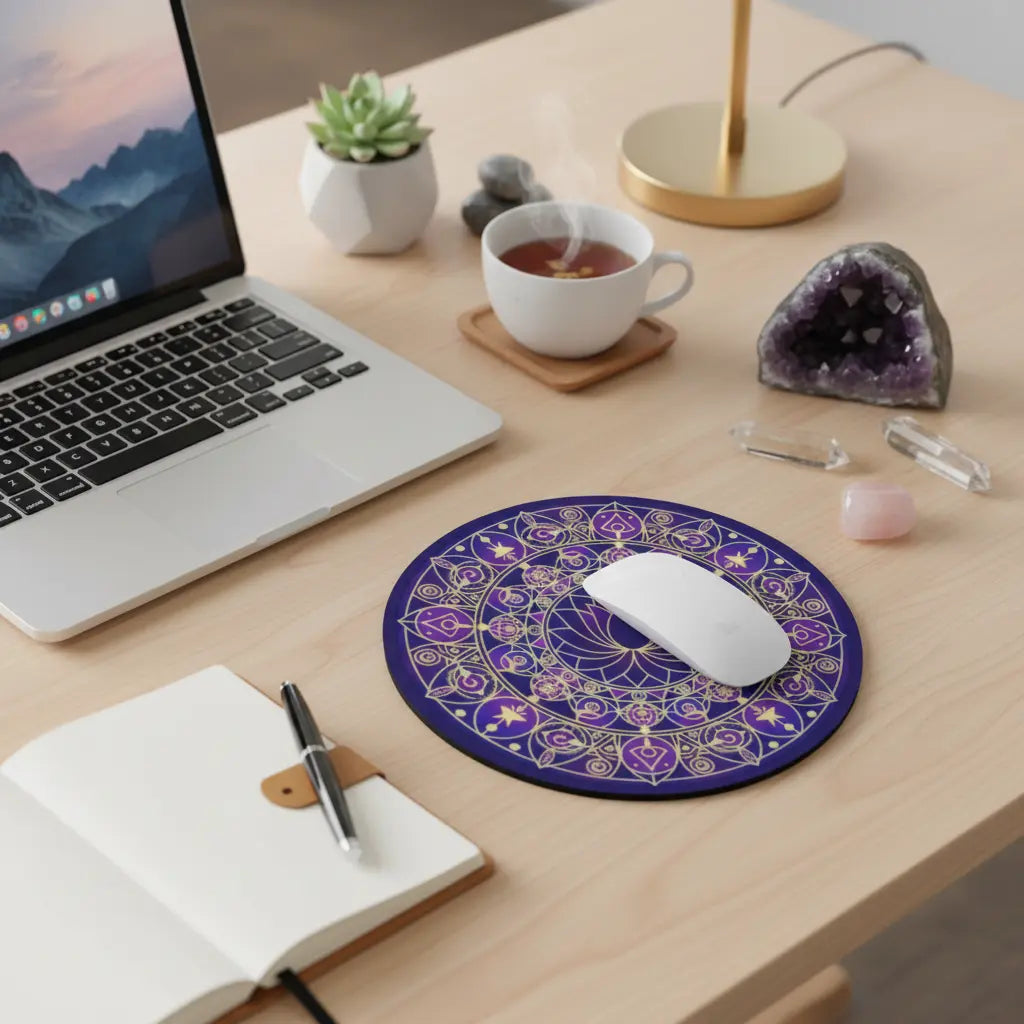
Mandala Circle Mouse Pad: Sacred Geometry Meets Digital Centering
A mandala is a sacred geometric configuration that represents the cosmos, the self, and the journey toward wholeness. Originating in Hindu and Buddhist traditions, the word "mandala" comes from Sanskrit, meaning "circle" or "center." This isn't just a decorative pattern—it's a spiritual technology designed to guide consciousness from fragmentation to integration, from chaos to order, from periphery to center. Every time you use this mouse pad, you're engaging with a 2,500-year-old practice of centering and wholeness.
Why Mandalas Work: The Psychology of Sacred Geometry
Carl Jung, who studied mandalas extensively, recognized them as universal symbols of the Self—the totality of the psyche, both conscious and unconscious. He observed that patients spontaneously drew mandalas during periods of psychological crisis and integration, using the circular form to contain and organize fragmented psychic material. The mandala serves as a container for chaos, a map for the journey inward, and a symbol of the integrated self.
The Structure of Mandalas: From Periphery to Center
1. The Outer Circle (Boundary): Represents the cosmos, the container that holds all experience. It creates a sacred boundary between the mundane world and the sacred space within. This is the protective barrier that allows inner work to happen safely.
2. The Geometric Patterns (Order): Symmetrical designs radiating from the center represent the organizing principles of the universe—the laws, patterns, and structures that govern reality. These patterns mirror the fractal nature of existence: the same patterns repeat at every scale, from atoms to galaxies.
3. The Center Point (Bindu): The still point at the heart of the mandala represents pure consciousness, the Self, the divine. All movement radiates from this center and returns to it. In meditation, the goal is to move from the chaotic periphery to the silent center—from distraction to presence, from fragmentation to wholeness.
4. The Four Directions (Orientation): Many mandalas incorporate the four cardinal directions, representing the four elements (Earth, Air, Fire, Water), the four stages of life, or the four aspects of consciousness. This creates a sense of orientation and balance.
Why a Circular Mouse Pad is Perfect for Mandala Practice:
1. Continuous Centering Practice: Traditional mandala meditation involves gazing at the mandala and allowing your awareness to be drawn from the outer edges toward the center. With a mandala mouse pad, every mouse movement becomes a micro-meditation—your hand traces circular patterns around the center, unconsciously reinforcing the centering impulse. You're not just working; you're practicing returning to center, hundreds of times a day.
2. Digital Work as Sacred Practice: Most people experience digital work as fragmenting—jumping between tabs, emails, notifications, tasks. A mandala mouse pad reframes your workspace as a sacred space, reminding you that even mundane tasks can be performed from a centered, integrated state. The mandala doesn't remove the chaos; it provides a stable center from which to engage with it.
3. Visual Anchor for Presence: When you feel scattered, overwhelmed, or lost in digital chaos, simply glancing at the mandala can serve as a visual anchor—a reminder to return to center, to breathe, to reconnect with your still point. The mandala becomes a symbol of your capacity to remain whole even when surrounded by fragmentation.
4. Circular Form Mirrors Wholeness: Unlike rectangular mouse pads, a circular pad has no corners, no edges, no beginning or end. This mirrors the nature of consciousness itself—boundless, continuous, whole. The circular form subtly reinforces the psychological experience of completeness rather than fragmentation.
5. Mandala as Integration Tool: Jung observed that creating or meditating on mandalas helps integrate unconscious material into conscious awareness. By placing a mandala in your daily workspace, you're creating a constant invitation for integration—bringing together the scattered parts of yourself (work self, creative self, spiritual self) into a unified whole.
6. Symmetry Calms the Nervous System: Neuroscience research shows that symmetrical patterns activate the brain's reward centers and create a sense of calm and order. The perfect symmetry of a mandala provides subtle nervous system regulation throughout your workday, reducing stress and promoting focus.
How to Use Your Mandala Mouse Pad as a Centering Practice:
Morning Activation (2 minutes):
• Before starting work, place your hand on the center of the mandala
• Close your eyes and take three deep breaths
• Visualize yourself as the center point—still, whole, complete
• Set your intention: "I work from my center today"
• Open your eyes and begin your work—the mandala is now activated
Micro-Centering Throughout the Day (30 seconds):
• When you feel scattered or overwhelmed, pause
• Gaze at the mandala for 3-5 breaths
• Allow your eyes to trace from the outer edge to the center
• Feel yourself returning to your still point
• Resume work from this centered state
Continuous Passive Practice (No Effort Required):
• Simply use the mouse pad normally
• Your hand naturally moves in circular patterns around the center
• This unconsciously reinforces the centering impulse
• Over time, the mandala becomes an automatic trigger for presence and wholeness
Product Specifications:
• Material: Neoprene with rubber backing
• Diameter: 8″ (20.3 cm)
• Smooth surface for accurate mouse control
• Non-slip bottom for stability
• Weight: 2.8 oz
• Blank product sourced from China
• Made on demand to reduce overproduction
For Seekers Who:
• Practice meditation, mindfulness, or contemplative traditions
• Want to integrate spiritual practice into everyday work
• Experience digital work as fragmenting and need a centering anchor
• Understand that sacred geometry is a technology for consciousness, not just decoration
• Appreciate that the journey from periphery to center is the journey from chaos to wholeness
• Know that the most powerful practices are the ones you engage with unconsciously, hundreds of times a day
This mouse pad is for practitioners who recognize that the mandala isn't just a beautiful pattern—it's a map of the psyche, a tool for integration, and a constant reminder that no matter how chaotic the external world becomes, you always have access to your still, whole center.
From periphery to center. From chaos to wholeness. 🕉️✨🎯