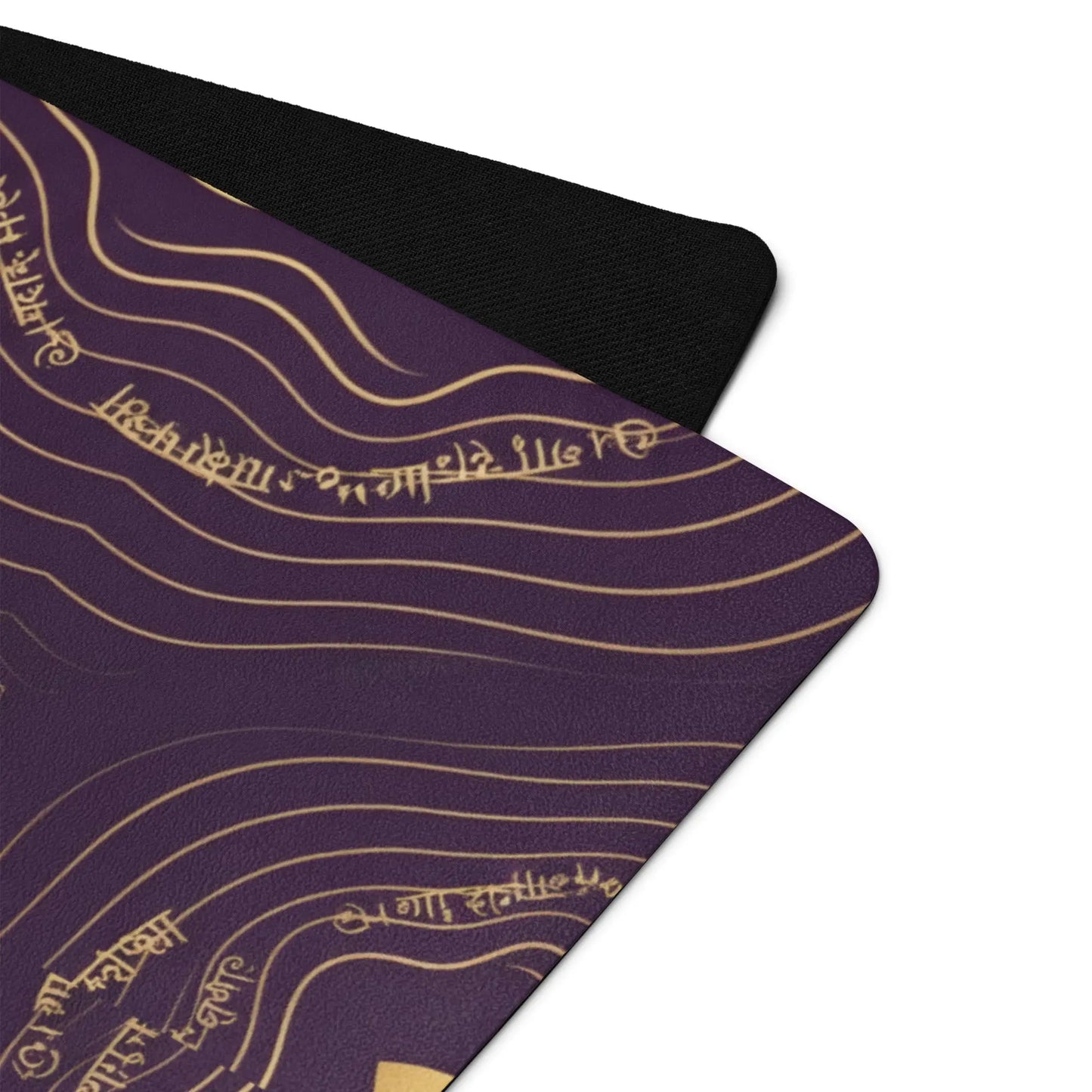
Om Symbol Yoga Mat: Practice on the Primordial Vibration
Om (ॐ) is not just a sound or a symbol—it's the primordial vibration from which the entire universe emerged. In Hindu and yogic philosophy, Om is considered the sound of creation itself, the cosmic hum that underlies all existence, the vibrational frequency of consciousness in its pure, undifferentiated state. When you chant Om, you're not making a sound; you're aligning your personal vibration with the universal vibration, tuning your individual consciousness to the frequency of the cosmos. This yoga mat places the Om symbol beneath your practice, transforming your mat into a vibrational field that reminds you with every breath, every asana, every meditation that you are not separate from the universe—you are the universe experiencing itself through your body.
Why Om Matters: The Sound That Contains All Sounds
Om is called "Pranava" (the primordial sound) and "Shabda Brahman" (the sound-form of the absolute). It's considered the most sacred syllable in Hinduism, Buddhism, and Jainism because it represents the totality of existence—past, present, and future; waking, dreaming, and deep sleep; creation, preservation, and dissolution. Om is not a word with a specific meaning; it's a vibration that contains all meanings, all sounds, all possibilities.
The Structure of Om: Three Sounds, One Silence
Om is actually composed of four parts, though it's often written as three:
1. A (Ah) - Creation, Waking State, Brahma:
• Sound: The first sound, originating from the throat
• Symbolism: The beginning, creation, birth, the waking state of consciousness
• Deity: Brahma, the creator
• State: Jagrat (waking consciousness), awareness of the external world
• Body: Gross physical body
• Practice: Grounding, standing poses, awareness of the physical body
2. U (Ooo) - Preservation, Dream State, Vishnu:
• Sound: The middle sound, rolling through the mouth
• Symbolism: Sustenance, preservation, the dream state of consciousness
• Deity: Vishnu, the preserver
• State: Swapna (dream consciousness), awareness of the internal world
• Body: Subtle energy body
• Practice: Pranayama, visualization, working with subtle energy
3. M (Mmm) - Dissolution, Deep Sleep, Shiva:
• Sound: The final sound, resonating in the head and beyond
• Symbolism: Dissolution, transformation, the deep sleep state of consciousness
• Deity: Shiva, the destroyer/transformer
• State: Sushupti (deep sleep consciousness), awareness dissolves into pure being
• Body: Causal body
• Practice: Meditation, Savasana, dissolution of ego
4. The Silence (Turiya) - The Fourth State, Pure Consciousness:
• Sound: The silence after the M fades, the space between chants
• Symbolism: The witness consciousness that observes all three states (waking, dreaming, sleeping) but is not identified with any of them
• State: Turiya (the fourth state), pure awareness, the Self
• Body: No body—pure consciousness beyond form
• Practice: The gap between breaths, the stillness between movements, the awareness that remains when all activity ceases
The Om Symbol (ॐ): Sacred Geometry of Sound
The written symbol ॐ is itself a sacred diagram:
• The curve at the bottom (3): Represents the waking state (A)
• The middle curve: Represents the dream state (U)
• The upper curve: Represents deep sleep (M)
• The dot (bindu): Represents Turiya, the fourth state, pure consciousness
• The semicircle (maya): Represents the veil of illusion that separates the three states from the fourth
Om in Different Traditions:
1. Hinduism - The Sound of Brahman:
Om is the sonic representation of Brahman (the absolute reality). The Mandukya Upanishad is entirely devoted to explaining Om, stating: "Om is the imperishable word. Om is the universe, and this is the exposition of Om. The past, the present, and the future, all that was, all that is, all that will be is Om. Likewise, all else that may exist beyond the bounds of time, that too is Om."
2. Buddhism - The Jewel in the Lotus:
In Tibetan Buddhism, Om is the first syllable of the most famous mantra: "Om Mani Padme Hum" (The jewel is in the lotus). Om represents the body, speech, and mind of the Buddha, and chanting it purifies the body, speech, and mind of the practitioner.
3. Yoga - The Pranava Mantra:
In yoga, Om is chanted at the beginning and end of practice to create sacred space, to align individual consciousness with universal consciousness, and to mark the transition from mundane to sacred time. It's considered the bija (seed) mantra from which all other mantras arise.
Why an Om Symbol Yoga Mat is Transformative:
1. Vibrational Alignment: The Om symbol on the mat serves as a constant visual reminder that your practice is not just physical exercise—it's a vibrational practice. Every movement, every breath is an opportunity to align your personal frequency with the cosmic frequency. The symbol becomes a tuning fork for consciousness.
2. Sacred Space Activation: In traditional practice, Om is chanted to sanctify space and time. Having the Om symbol on your mat means that every time you unroll it, you're creating sacred space. The mat becomes a portable temple, a vibrational field that transforms any location into a place of practice.
3. Integration of All States: The Om symbol reminds you that yoga practice integrates all states of consciousness—not just the waking state (physical asana) but also the dream state (visualization, subtle energy work) and deep sleep (meditation, dissolution). Your practice becomes a journey through all three states toward the fourth (Turiya, pure awareness).
4. The Power of Silence: The most important part of Om is the silence after the M—the Turiya state. The symbol reminds you that the goal of practice is not constant activity but the stillness that remains when all activity ceases. The mat becomes a visual anchor for cultivating the witness consciousness that observes all states without identification.
5. Mantra Practice Integration: Having the Om symbol visible during practice naturally invites mantra practice. You can chant Om silently or aloud during asana, coordinate it with breath (inhale on A-U, exhale on M, pause in the silence), or use it as a meditation anchor. The symbol makes mantra practice accessible and integrated rather than separate.
6. Universal Connection: Om represents the understanding that you are not a separate individual practicing yoga—you are the universe practicing yoga through this particular body-mind. The symbol dissolves the illusion of separation, reminding you that your breath is the cosmic breath, your movement is the cosmic dance, your awareness is the cosmic consciousness.
How to Practice with Your Om Symbol Yoga Mat:
Opening Om Chant (Sacred Space Creation):
• Sit at the center of the mat, facing the Om symbol
• Take three deep breaths to center
• Chant Om three times:
- First Om: Purify the space
- Second Om: Purify the body
- Third Om: Purify the mind
• Rest in the silence after the third Om before beginning practice
Three-Part Om Practice (A-U-M Integration):
• A (Waking/Physical): Practice dynamic asanas, standing poses, strength work—engage fully with the physical body
• U (Dreaming/Subtle): Practice pranayama, visualization, subtle energy work—engage with the energy body
• M (Deep Sleep/Causal): Practice meditation, Yoga Nidra, deep relaxation—dissolve into pure being
• Silence (Turiya/Pure Awareness): Rest in Savasana, simply witnessing, no doing
Om Breathing Meditation:
• Lie in Savasana with the Om symbol at your crown
• Inhale silently on "A-U" (2 counts)
• Exhale silently on "M" (2 counts)
• Pause in the silence (2 counts)
• Continue for 10-20 minutes, feeling the vibration of Om even in silence
Closing Om Chant (Integration):
• Sit at the center of the mat
• Chant Om three times:
- First Om: Gratitude for the practice
- Second Om: Integration of the experience
- Third Om: Offering the practice to the universe
• Bow to the Om symbol, acknowledging the divine within and without
Product Specifications:
• Material: Rubber mat with microsuede top
• Anti-slip rubber bottom (stability)
• Size: 24″ × 68″ (61 cm × 173 cm)
• Weight: 62 oz (1.75 kg)
• Mat thickness: 0.12″ (3 mm)
• Product sourced from China
• Made on demand to reduce overproduction
For Seekers Who:
• Practice yoga, meditation, or mantra chanting
• Understand that sound is vibration and vibration is consciousness
• Want to align their personal frequency with the cosmic frequency
• Recognize that the goal of practice is not constant activity but the stillness that remains when all activity ceases
• Appreciate that Om contains all sounds, all states, all possibilities
• Know that you are not separate from the universe—you are the universe experiencing itself
This yoga mat is for practitioners who understand that Om is not just a symbol to display or a sound to chant—it's the primordial vibration of existence itself, and that every practice is an opportunity to tune your individual consciousness to the frequency of the cosmos, to dissolve the illusion of separation, and to rest in the silence of pure awareness.
A-U-M... Silence. The sound of the universe. The vibration of consciousness. Om Shanti Shanti Shanti. 🕉️✨🕊️